EDF Energy Renewables

Frequently Asked Questions

Are wind turbines noisy?

Wind turbines are not noisy. The evolution of wind farm technology over the past decade has rendered mechanical noise from turbines almost undetectable with the main sound being the aerodynamic swoosh of the blades passing the tower. There are strict guidelines on wind turbines and noise emissions to ensure the protection of residential amenity. It is possible to stand underneath a turbine and hold a conversation without having to raise your voice. As wind speed rises, the noise of the wind masks the noise made by wind turbines.

Do wind turbines produce low frequency noise?

There is always low frequency noise present in any ambient quiet background and it can be produced by a variety of man-made sources, including machinery and transport and natural sources such as the sea, wind and thunder. It has been repeatedly shown by measurements of wind turbine noise undertaken in the UK, Denmark, Germany and the USA over the past decade, and accepted by experienced noise professionals, that the levels of low frequency noise and vibration radiated from modern, upwind configuration wind turbines are at a very low level, so low that they lie below the threshold of perception.

Why don't they make turbines that look like old fashioned windmills?

The old fashioned windmill is viewed with nostalgia, and some people prefer the look of them to that of their modern counterparts. Just because wind turbines are modern, it doesn't mean they won't look just as good over time.

A modern wind turbine is simply an improved windmill. Every aspect of their design has been optimised, making them far more efficient than old style windmills at generating electricity. To make them look more old-fashioned would just result in more expensive electricity.

Why don't we put all the wind turbines out to sea?

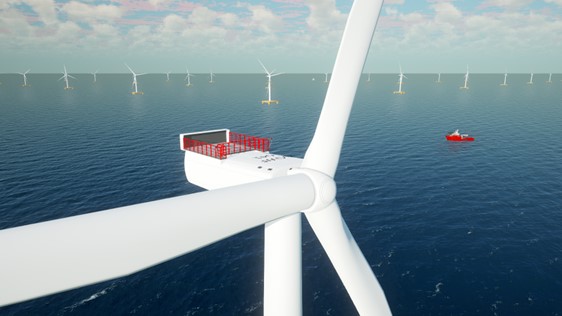
We will need a mix of both onshore and offshore wind energy to meet the UK's challenging targets on climate change. At present, onshore wind is more economical than development offshore. Furthermore, offshore wind farms take longer to develop, as the sea is inherently a more hostile environment. To expect offshore to be the only form of wind generation allowed would therefore be to condemn us to miss our renewable energy targets and commitment to tackle climate change.

EDF Energy Renewables is already developing and offshore windfarm at Redcar, Teesside. The project will consist of up to 30 turbines – capable of producing up to 90MW of electricity – enough to supply the entire annual requirements of all the households in Redcar and Cleveland.

The windfarm was granted section 36 consent by BERR in September 2007, and it is expected that the windfarm will be commissioned around 2011.

Do wind turbines frighten livestock?

Wind farming is popular with farmers, because their land can continue to be used for growing crops or grazing livestock. Sheep, cows and horses are not disturbed by wind turbines.

EDF Energy Renewables already operates windfarms on land where livestock are kept at its sites at High Hedley Hope and Kirkheaton and the animals can be seen grazing right next to and under the turbines.

How long does it take for a turbine to 'pay back' the energy used to manufacture it?

The comparison of energy used in manufacture with the energy produced by a power station is known as the 'energy balance'. It can be expressed in terms of energy 'pay back' time, i.e. as the time needed to generate the equivalent amount of energy used in manufacturing the wind turbine or power station.

The average wind farm in the UK will pay back the energy used in its manufacture within six to eight months, this compares favourably with coal or nuclear power stations, which take about six months.

How safe is wind energy?

Wind energy is one of the safest energy technologies. It is a matter of record that no member of the public has ever been injured during the normal operation of a wind turbine, with over 25 years operating experience and with more than 70,000 machines installed around the world.

Does wind farming affect tourism?

There is no evidence to suggest this. The UK's first commercial wind farm at Delabole received 350,000 visitors in its first ten years of operation. A MORI poll in Scotland showed that 80% of tourists would be interested in visiting a wind farm. Furthermore, wind farm developers are often asked to provide a visitor centre, viewing platforms and rights of way to their sites.

What are wind turbines made of?

The towers are mostly tubular and made of steel, generally painted light grey. The blades are made of glass-fibre reinforced polyester or wood-epoxy. They are light grey because this is the colour which is most inconspicuous under most lighting conditions. The finish is matt, to reduce reflected light.

How big are they?

Large modern wind turbines have rotor diameters ranging up to 65 meters while smaller machines (around 30 meters) are typical in developing countries. Towers range from 25 to 80 meters in height.

How strong does the wind have to blow for the wind turbines to work?

Wind turbines start operating at wind speeds of 4 to 5 metres per second (around 10 miles an hour) and reach maximum power output at around 15 meters/second (around 33 miles per hour). At very high wind speeds, i.e. gale force winds, (25 metres/second, 50+ miles/hour) wind turbines shut down.

How fast do the blades turn?

The blades rotate at anything between 50-10 revolutions per minute at constant speed. However, an increasing number of machines operate at variable speed.

How long do wind turbines last?

A wind turbine typically lasts around 20-25 years. During this time, as with a car, some parts may need replacing.

The very first of the mass-produced turbines celebrated its 20th birthday in May 2000. The Vestas 30kW machine has operated steadily throughout its lifetime, with none of the major components needing to be replaced.

What happens when a wind farm is taken down/decommissioned?

The way that a local authority wishes to have a wind farm decommissioned should be covered by clauses in its planning permission. These clauses typically require all visible traces of the wind farm to be removed. This takes care of the turbines. Service tracks, if there are any, could be removed, although it may be best to leave them. Obviously each case is different, depending upon the size and geography of the development. Developers will then comply with these clauses.

The concrete bases could be removed, but it may be better to leave them under the ground, as this causes less disturbance. If so, they would be covered with peat, stone or other indigenous material, and the site returned as closely as practicable to its original state. The turbine itself will often have a scrap value which will cover the costs of such ground restoration.

Wind energy technology is essential reversible, and compared to the problems associated with decommissioning a nuclear power station, or a coal or gas fired plant, decommissioning a wind farm is straight forward and simple.

How efficient are wind turbines?

The theoretical maximum energy which a wind turbine can extract from the wind blowing across it is just under 60%, known as the Betz limit. However the meaning of efficiency is a redundant concept to apply to wind energy, where the fuel is free. The primary concern is not the efficiency for its own sake, but to improve productivity in order to bring the price of wind energy down.

How much does it cost to make electricity from the wind?

Wind energy is one of the cheapest of the renewable energy technologies. It is competitive with new clean coal fired power stations and cheaper than new nuclear power. The cost of wind energy varies according to many factors. An average for a new onshore wind farm in a good location is 3-4 pence per unit.

How much of the time do wind turbines produce electricity?

A modern wind turbine produces electricity 70-85% of the time, but it generates different outputs dependent on wind speed. Over the course of a year, it will generate about 30% of the theoretical maximum output. This is known as its load factor. The load factor of conventional power stations is on average 50%.

How much electricity does one wind turbine produce?

One 1.8 MW wind turbine at a reasonable site would produce over 4,7 million units of electricity each year, enough to meet the annual needs of over 1,000 households, or to run a computer for over 1,620 years.

Source BWEA

(For inclusion in the technology section):

How does a wind turbine make electricity?

The simplest way to think about this is to imagine that a wind turbine works in exactly the opposite way to a fan. Instead of using electricity to make wind, like a fan, turbines use the wind to make electricity.

Almost all wind turbines producing electricity consist of rotor blades which rotate around a horizontal hub. The hub is connected to a gearbox and generator, which are located inside the nacelle. The nacelle is the large part at the top of the tower where all the electrical components are located.

Most wind turbines have three blades which face into the wind; the wind turns the blades round, this spins the shaft, which connects to a generator and this is where the electricity is made. A generator is a machine that produces electrical energy from mechanical energy, as opposed to an electric motor which does the opposite.

Return to top